Showing posts with label extraction. Show all posts

Tuesday, November 29, 2011

Implant case

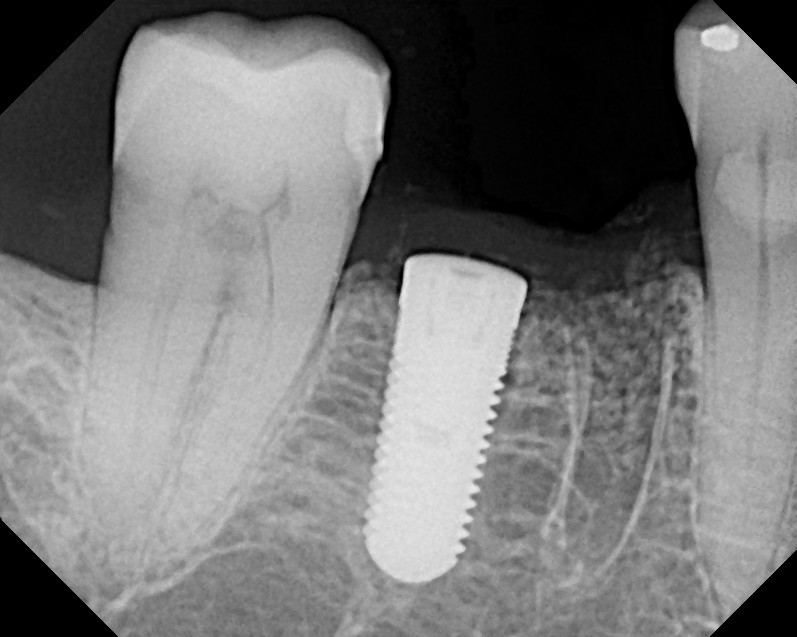
Here is an implant case that we did several months ago.
The patient came in with a broken lower molar.
She decided that instead of trying the heroic measures necessary to save her own tooth that she would get an implant placed.
The extraction and immediate implant placement went very well.
The healing took place over an 8 week period.
The abutment was in for an additional 2 weeks.
The crown was then placed this morning.
Wonderful alternative to root canals, posts, core buildups, etc.

Monday, November 21, 2011

What is an underbite


Typically your upper teeth protrude out over your lower teeth.
This makes it so that when you close your teeth you see mainly see your upper teeth.

In some cases the lower teeth will cover the upper teeth when you close.
This is known as an under bite.

Under bites can come in two forms.
#1 is a problem with the tilt of the teeth.
If the lower teeth are flared out or the top teeth are pushed in then an under bite may occur.
This problem can usually be corrected very easily with orthodontics.

#2 is a skeletal problem.
This means that the lower jaw grew to far out or the upper jaw didn't grow
out far enough or both.
This kind of under bite can also be corrected with orthodontics, but
in severe cases may require surgery to fix.
Best thing to do is to get your child to an orthodontist if you suspect that trouble.


Tuesday, November 8, 2011

Wednesday, October 19, 2011

It's just a little spot. No big deal. Right?


Enamel is the white stuff that makes up the outer covering of your teeth.
Enamel is the strongest substance in your body.
It is very difficult for bacteria to penetrate this layer.
Once it does however, the next layer, dentin, is much softer and easier to get through.
Therefore, all it takes is one little spot of decay to get into your tooth
and you could be in serious trouble.

Once bacteria are on the inside of the tooth they begin to multiply.
Bacteria need food, water, and warmth to multiply.
And your mouth has an abundance of all three.

Here is a before and after picture of a case that we just did today.
The patient came in complaining of intense pain but did not know why
as her tooth only showed the most mild of decay.

First picture shows the tooth before we started.
Only a small amount of decay present.
This picture shows the insides of the tooth after the decay was taken out.
The holes in the bottom are the places where the nerve used to be.
This tooth ended up getting a root canal.
Be careful. Any discoloration may be too much.
Get it checked out.


Monday, October 3, 2011

The evolution of an implant.


The evolution of an implant.

#1 Somehow acquire a bad tooth.
Break it off at the gums, have a root canal that fails, etc.
(example of tooth broken off at gums)
#2 Get the tooth extracted and then place the implant.
#3 Attach a post to the implant.
This will serve as a platform on which to place the crown.
#4 Place a crown on the post and you are back to full function.
This entire project took about 3 months to complete.
The patient is very happy with the results.


Monday, September 26, 2011

What is a cleft lip and palate?

The word "cleft" simply means a crack or divide. A cleft lip is simply the body incorrectly or incompletely closing the facial structures during development. This incomplete closing leaves a cleft, or divide, in the lip and/or palate of the new born. Below is an ultrasound showing a cleft lip
Clefts can be simply the lip (cleft lip).
Or they can be more severe and include the palate (cleft lip and palate).
In the cleft lip and palate the teeth are often involved.
Missing, misaligned, and or misplaced teeth can be common.
Clefts, no matter the severity, are normally very repairable
and the scare can be almost unrecognizable.


Monday, September 12, 2011

Implant case

Wrapped up this case on Friday of last week.
Patient broke off half of her tooth.
The break was severe and extended down under the gums.
Patient did not want a bridge so an implant was chosen.
(Digital picture of tooth)
(X-Ray of tooth)

After the extraction both root sockets were examined and it was
determined that the socket farthest back would work best for the implant.

The implant was placed.
Bone grafting material was placed in the front most socket.
The spot was then stitched shut.
The implant is at bone level and the outcome for this case is extremely favorable.
The patient will now wait for about 6 weeks to make sure
that the implant site heals completely.

After that a tooth will be attached to the implant
and she will be back to her old self.

There are certain situations in which they don't work
but for the most part implants are wonderful.


Friday, September 9, 2011

Does your jaw pop or click?

TMJ is the abbreviation for Temporal Mandibular Joint. It is the joint directly in front of your ear that is used by your body to open and close your mouth. It is, like most other joints in your body, made up of cartilage, fluid, bones, and muscles.. And just like any other joint in the body any piece to this puzzle can deteriorate, get misplaced, damaged, or have any other number of problems.
If any sort of damage does occur then pain, clicking, popping may result.
If you have had any of the above symptoms the best thing to do
is to see your dentist right away.
He/she needs to determine what is the cause of your TMJ discomfort and
what, if anything, can be done to solve the problem.


Thursday, September 8, 2011

What is the black line around my crown?

Nothing is wrong.
What you are seeing is simply the metal that your crown is
made out of showing out from underneath.
I know I know, you thought that your crown was white and that
there wasn't any metal in it.
Well, there is. You have what is referred to as a porcelain
fused to metal crown of (PFM).
The crown is made of a metal substructure to give it it's strength and
then porcelain is layered over the top to make it look like a tooth.
The PFM has been used for years and has had remarkable success.
The only draw back to these types of crowns is the metal line showing through
and the fact that the porcelain layers can begin to separate from each other
and cause the pieces of porcelain to fall off the crowns.

Today there are new advances in crown technology that have
eliminated both of these problems.
There is a new material, to the world of dentistry that is, called zirconium.
Zirconium crowns are milled from a solid block and are very very strong.
This milling process means that they are not put together piece by piece.
Therefore there are no pieces to come apart. The crown is one solid unit.
Zirconium is also white so the color is that of most teeth and will never show a
metallic line because there is no metal.


Wednesday, September 7, 2011

Implant case from yesterday.


Just finished up a nice implant case.
Patient came in with one of his four front teeth broken off at the gum line.
(Pictured here)
The big problem was that he already had bridges on both sides of the broken tooth.
Since he didn't want to destroy a good bridge he went for the implant.
We extracted the tooth, placed the implant, and placed a temporary on it the same day.
The patient returned in 8 weeks to receive the final crown.
He is very happy with the result.
(Pictured below)

Wednesday, August 31, 2011

Just take out all my teeth!


Every once in a while we will get someone who asks us to take
all of their teeth out and just give them dentures.
In almost all cases the answer to this is no.


The reason for this is because these people are looking for a fix.
A fix to all of their dental problems.
They figure that if they have no teeth then they can't have anymore mouth problems.


Oh how wrong that is.
Dentures come with their own set of problems.
Do they fit?
Will they stay in?
Can I chew with them?
Etc.
Etc.


Now, for some people a denture is absolutely the right way to go.


But for most there are other options.
And once you go with a denture you can never go back to real teeth.


Its kind of a, the grass is always greener on the other side mentality.
Do dentures work?
Yes.
But they require work, cleaning, and care just like teeth do.
If you aren't willing to work on your teeth then the problems you
had with your teeth will follow you to your dentures.


Monday, August 29, 2011

How do I say this gently?


Almost everyday I have to tell someone, that has
never had a cavity, that they have a cavity.


Many of these people are in the 50's or 60's.


They spend lots of time brushing and flossing and have never had a
cavity and don't understand how they now are getting cavities when
they are doing the same things that they have always done to keep their teeth clean.


At this point I have to be very diplomatic.


The simple answer is...... you are getting older.


As we age things will begin to break down.


These people have no problem accepting that their eyesight isn't what is used to be.
Or that their hearing may be a little worse then it was when they were younger.
But for some reason, the fact that their teeth are also wearing down is a new concept.


Every part of our bodies will break down over time.
Teeth will follow right along with the rest of it.


The forces of a lifetime of chewing mixed in with the fact that salivary flow
rates decrease as we age (thus less protection for our teeth) means that
an increase in cavities over time is almost inevitable.


Thursday, August 25, 2011

Teething in a 6 year old?

Teething pains. In a six year old.

We all know about the teething that happens in the first year of your child's life.
But not too many people are familiar with the teething that happens when a child in 6.
At the age of 6 years old, or so, your child will get in their first adult molars.
They are called, 6 year molars.
These teeth are the largest teeth that anyone will ever have in their mouths.
These teeth are not the little pointy teeth that little kids get in the front of their mouths.
These teeth are large and flat.
They need to place more force in order to break through the gums then the little ones do.


Therefore, if your child is around the age of 6 years and they complain about pain
way in the back of their mouth they may just be teething all over again.
Its always a good idea to get things checked out by a dental
professional just to insure that they do not have active cavities causing this ache.
But more often then not it will simply be the child's first molars coming in.


The best thing to do is treat this case of tooth eruption just like the others.
A mild over the counter pain killer such as Tylenol or ibuprofen and
then some orajel at the spot the tooth is coming in.


Tuesday, August 23, 2011

Veneers with no drilling or shots


Much has been made in the media recently about getting veneers.


Veneers are a great product.


They can fix a multitude of problems such as discoloration,
slight tooth rotations and crowding.


There are two types of veneers however.


The one that I will talk briefly about today is the kind of veneer called no-prep.


These veneers require no shots. No drilling. And disturb non of the natural tooth structure.


The patient simply comes to the dentist, gets a few impressions taken,
and shows up 2 weeks later to get the veneers placed.


The veneers are basically like fake fingernails except they do not need to be replaced
except for the rare case that they were to break off.


The only down side is that these types of veneers may make your teeth look a little bulky.


They are only .3 mm thick. But still your mouth is sensitive enough
to feel a human hair. So even at .3 mm they may take some getting used to.


I would highly recommend that if you have ever thought about veneers
that you take a look at some of these no-prep products.


Wednesday, August 17, 2011

It shouldn't be too hard to pull out, should it?


This happens all the time.
People, who neglect their teeth, will wait until they have a tooth that is
broken off at the gums to come to my office to get it extracted.


The laugh a little nervous laugh and say...
"well, not much left so it should be pretty easy yo pull out, huh?"


The answer to that is, NO.
Imagine getting a fence post out of the ground.
Not the easiest thing in the world, right?
Now, take a chain saw and cut the fence post off at the ground.
How easy is that going to be now?!


If you want a tooth out, please, please, please, do not wait until
it is so broken down that there is nothing to grab on to.
It is NOT easier.


Tuesday, August 16, 2011

Pointy Canines


Canines are unlike any other teeth in the mouth.
Every other tooth in the mouth is, almost, a copy of a another tooth in the same quadrant.
You have 2 incisors, 2 pre-molars, and 2 molars per quadrant but only 1 canine.
These teeth are also, typically, the longest rooted teeth in the mouth.


One problem that people have with their canines is that sometimes
they feel as if they are a bit too pointed.


They hide them when they smile for fear that they look too much like a vampire.


Well there has never been an easier fix for just about anything.


All you need to do is file those bad boys down just a bit.
You do not need to be numbed up and it will only take a moment to do.
You will have less enamel so the chances that you could get decay in the
future are slightly higher. But, there is hardly anyone ever that gets
cavities on the points of their canines. Just doesn't happen.
Food can't stick there very easily.


Tuesday, August 9, 2011

Baby Root Canal


Children's teeth are similar to adult teeth in many ways.
They can both decay.
And the decay can get large enough that it can effect the nerve of the tooth.
In the case of an adult a tooth with an infected nerve would need a root canal.
In a child's tooth it would called a pulpotomy.
In both cases the nerve in the tooth is removed in order to help the tooth stop hurting.
One of the main differences here is the rate of success between the 2 procedures.


Root canals are, typically, very predictable.
Pulpotomys are much less so.


One reason for this is that the roots of an adult tooth are stable.
They have formed and are not going anywhere.
The roots on a child's tooth are ever changing.
The adult teeth coming in behind them are applying more and more
pressure to the baby teeth in order to force them out of the way so
that they, the permanent teeth, may erupt through the gums.


With this ever changing root structure, and not wanting to possibly damage the
permanent tooth under the baby tooth it is much more difficult to get a
pulpotomy to work then it is a root canal.


The one huge advantage that children have over adults in this
situation is that the baby teeth will fall out and the adult teeth shouldn't.


If a pulpotomy does happen to fail then removing the tooth is always
an option. And we just need to wait for the adult tooth to grow into its place.


Friday, August 5, 2011

Painless tooth replacement.

"Painless tooth replacement"
"Teeth in a day"

We have all heard these claims and typically they are accompanied by promises that the doctor can,
almost magically, take out all of your teeth, put implants in, and place crowns on the teeth
with little to no pain, in just one day.
They may even show the patient biting into an apple right after the procedure.

In very rare and unique circumstances this MAY be the case. But for the other 99.7% of us, its not.
anytime you have surgery of ANY kind you need to heal.
The picture below shows a site where a tooth was recently extracted.
This site will be very tender for several days while the body heals.
That's just the way it works. Blood will rush to the site of any injury thus
creating inflammation (swelling) and moderate discomfort.

If implants are placed that too will cause some type of discomfort.

To say that teeth can be extracted and implants placed and that you can begin
eating right away with no pain whatsoever is just not true. What is typically
happening is that these people are trying to suck you in and then sell you on something else.

Simply do lots and lots of homework before letting these places touch your mouth.


Thursday, July 28, 2011

Periodontitis


Periodontitis is a condition where the gums and bone that surround your
slowly deteriorate to to large amounts of, unremoved, bacteria.

I have seen perfectly healthy teeth be pulled out of someones mouth with
their own fingers because the gums and bone could no longer support them.

It is an absolute must that you get into your dentist at lease once a year to
get the bacteria plaque and other contaminants removed from your teeth
to maintain good gum and bone health.

Here are some healthy gums.
Here are some gums that are in trouble.
One of the symptoms of periodontal disease is swollen, red, painful gums.
This patient is also in trouble.
Another symptom of periodontal disease is that your teeth will begin to loosen up.
As the bone looses its ability to hold the teeth in
you teeth will shift and, or drop out of the gums.
Please please please get to your dentist for a good cleaning BEFORE your
mouth begins to resemble one of these last two pictures.